
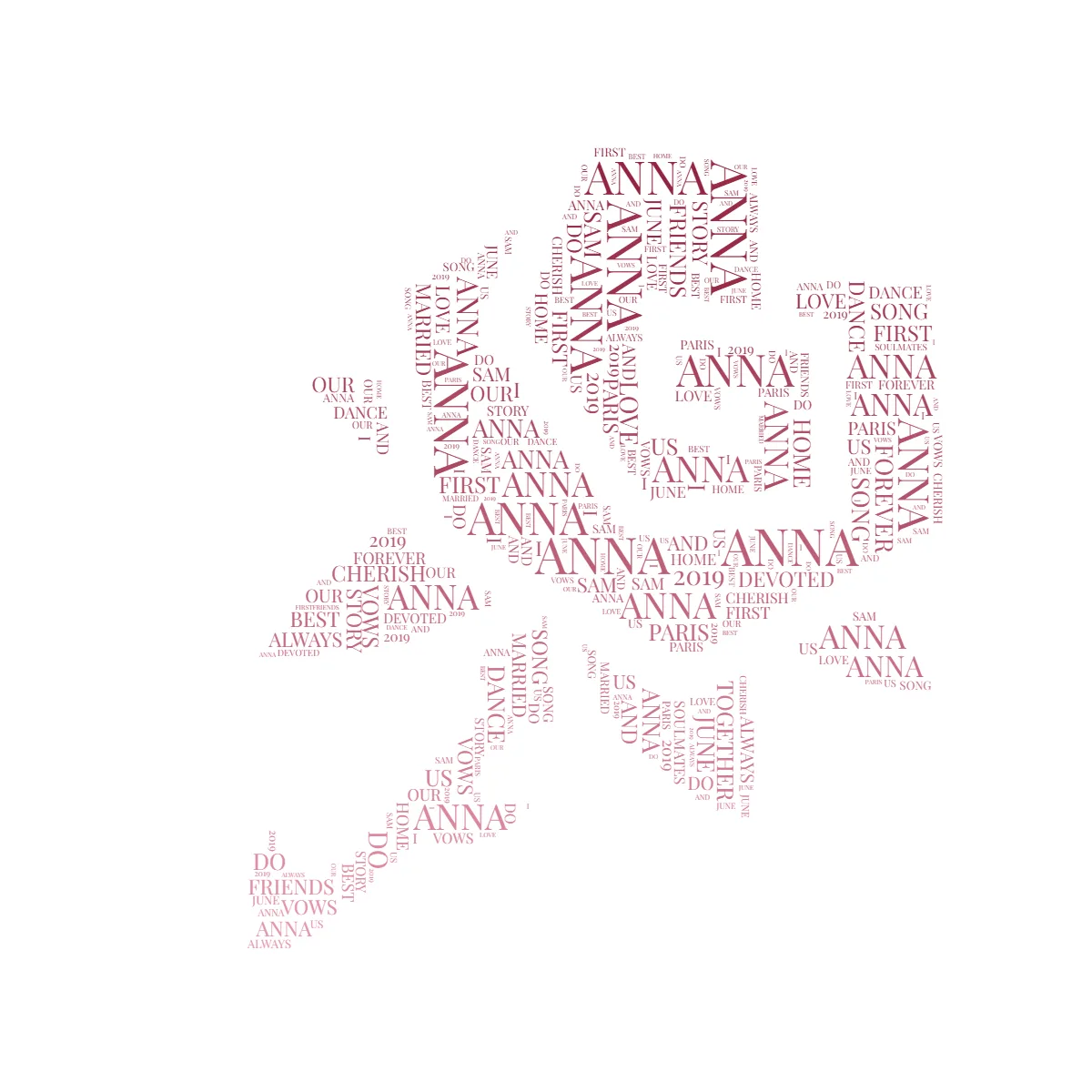
A personalized word-art print, a heart or a rose filled with a couple's names, dates, and the song from their first dance, sells for around $40 on Etsy or at a local print shop. If you're the one buying, the money isn't really paying for the design. It's paying for the assembly. The thing that makes the print mean anything, the actual words, is the one thing the seller can't know. You have to hand it to them. So you may as well make the whole thing yourself, which takes a few minutes and costs nothing.
A word-art print works on two levels. From across the room it's a shape. Up close it's a list, and every word is a specific memory: the street where you met, the nickname nobody outside the marriage understands, the date you'd both forget if it weren't hanging on the wall. Most gifts say "I thought of you." This one says "I remembered all of it."
These lists get private, which is rather the point, so it's worth knowing the tool runs in your browser and nothing you type is uploaded anywhere. The mechanics are the same as any other project: picking a shape, choosing a layout, setting color, and exporting a print file are all covered in the main guide, how to make word art. For a couple, the quickest start is the heart or the more formal rose, or the rest of the love templates. The part worth slowing down for is the list.
What to put in it
The strongest lists mix three kinds of entry: anchors (the names and the date), places, and the small things only these two people would recognize. Twenty to fifty entries fills most shapes without any single word losing its weight. Two or three of those entries should be featured so they render large and the print has a focal point instead of an even wash of text (the how of featuring is in the pillar).
For an anniversary
- Both names, and the nicknames you actually say out loud
- The wedding date, plus the date you met if you know it
- Places: the city you met in, the honeymoon, the street of the first apartment
- The first-dance song, or "your" song
- Kids' names, pets' names
- The inside jokes, including the ones that need no explanation because only two people will ever get them
- A short line from the vows
- Quiet words that carry weight: still, always, home, us
For a wedding
- The couple's first names, and the shared surname if one of them is taking it
- The date and the venue
- "Mr & Mrs", or whichever pairing fits
- Words lifted straight from the invitation or the ceremony reading
- The city where they're setting up
- I do, forever, beginning, family
For an engagement
- Yes, made the largest word on the piece, because it's the whole story
- The spot where it happened, and the date
- Both names
- The wedding date, if there's one yet
- Future, beginning, forever, us
A quick test for any entry: if it could sit in a stranger's print, it earns a place only when it's true; if it could only sit in this one, it's in automatically.
Printing and framing
Export at high resolution (up to 4K, roughly 4,000 pixels on the long edge) and you have more detail than any common frame size needs. Print sharpness is measured in dots per inch, and 300 DPI is the usual benchmark for something read up close. Here's how a 4K file lands across sizes:
| Frame size | Approximate resolution | Verdict |
|---|---|---|
| 5 × 7 in | ~570 DPI | Extremely sharp |
| 8 × 10 in | ~400 DPI | Extremely sharp |
| 11 × 14 in | ~285 DPI | Sharp |
| 16 × 20 in | ~200 DPI | Sharp at wall-viewing distance |
Anything up to 11 × 14 stays crisp even when someone leans in to read the smallest words, which, with a gift like this, they will. At 16 × 20 and larger the print still reads cleanly from where you'd actually stand to look at wall art, since nobody reads a big frame from three inches away.
A few things that make a home print look like a shop one:
- Paper: matte or satin photo paper suits text and kills the glare you get behind frame glass. Heavyweight matte card stock is good for the smaller sizes.
- Printing it: a home inkjet handles 5 × 7 and 8 × 10 fine. For anything bigger, a print shop or online photo printer takes the PNG as-is, no special file format needed. And if the gift is a vinyl decal rather than paper, the editor also exports a cut-ready SVG that a Cricut or Silhouette takes directly.
- Framing: leave room. A mat between the print and the frame is most of the difference between a homemade piece and a finished one, and the heart and rose in particular want some white space around the silhouette.
- Proofing: run one draft on plain paper and check the smallest words are comfortably legible at your chosen size. If they aren't, feature fewer words or cut the list, and everything left gets bigger.
The design is the quick part. The list is the gift, so give it an evening: dates, places, songs, the jokes, and ask a sibling or a close friend for the entries you've forgotten. Then paste it in, mark the two or three that matter most, and print a plain-paper draft before you commit to the frame.
Making one for new parents instead? The same approach runs nursery word art.